Stealth Entries: How Wonging Transforms Card Counting in Blackjack
Stealth Entries: How Wonging Transforms Card Counting in Blackjack
Card counting in blackjack has long served as a mathematical edge for skilled players, yet traditional methods expose counters to casino scrutiny since they play every hand; enter Wonging, a stealthy variation that flips the script by allowing observers to lurk tableside, scanning counts without betting until the deck turns rich in high cards, and that's where the real transformation begins.
The Roots of Wonging in Blackjack Strategy
Stanford Wong, a pivotal figure in advantage play, first detailed this approach in his 1994 book Professional Blackjack, building on earlier concepts from the 1970s when teams like the MIT group experimented with back-counting; researchers tracing the technique note how it evolved from basic Hi-Lo systems, where players track aces and tens against low cards, but Wonging adds a layer of invisibility since spotters hover without action, slipping into seats only when the true count hits plus-two or higher, thus minimizing losses during negative decks.
What's interesting is how this method, named after Wong himself, spread through underground forums and books by the 1980s; data from gaming archives shows counters adopting it widely because casinos then focused heat on consistent players, not ghosts flitting between tables, adn experts who've dissected play logs reveal win rates jumping 1-2% over straight counting since less time gets wasted on poor shoes.
Take one team in Atlantic City during the late '90s: they wonged multiple six-deck games, entering mid-shoe when counts soared, and reports indicate they extracted edges near 2.5% without drawing pit boss ire until patterns emerged; such cases highlight why Wonging reshapes the game, turning blackjack into a hit-and-run affair rather than a marathon grind.
Mastering the Mechanics: From Back-Counting to Entry Signals
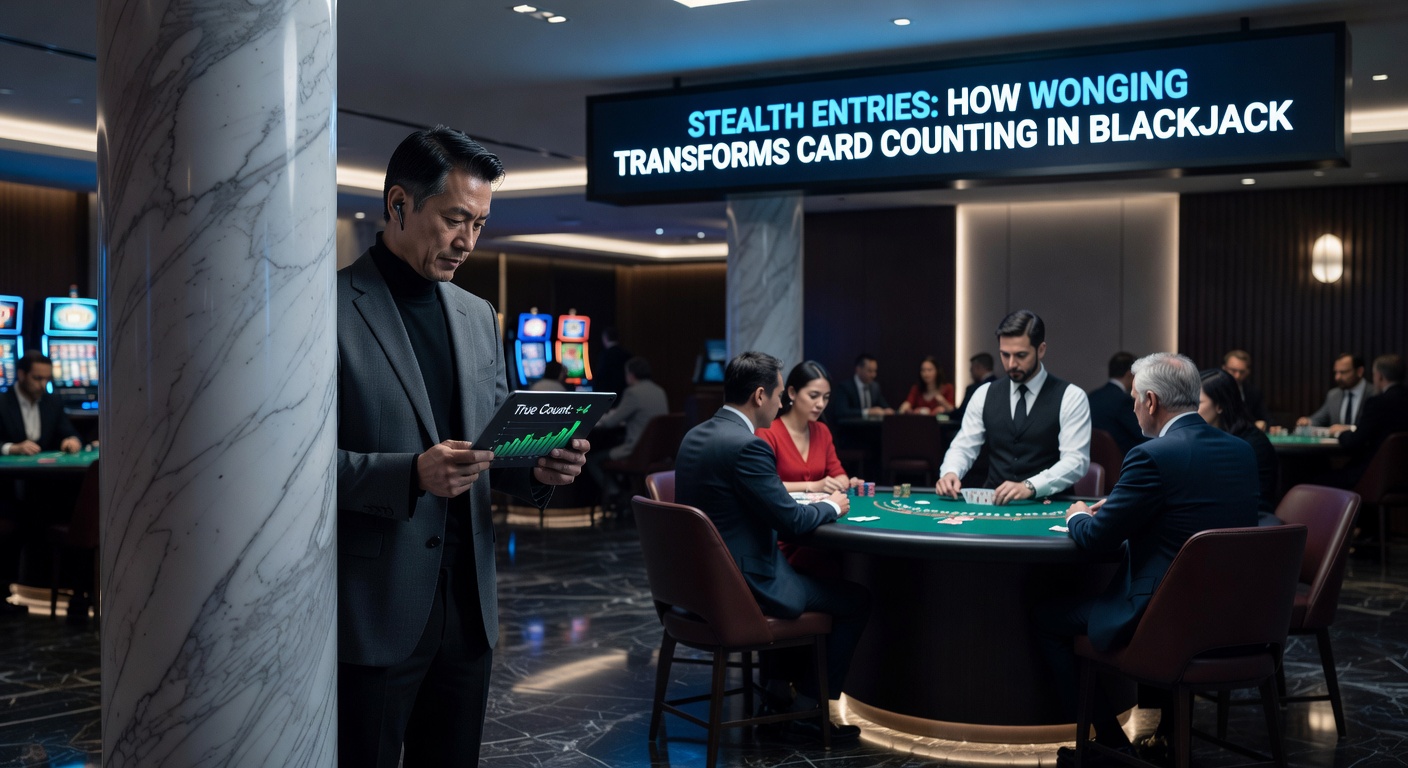
Back-counting forms the core, where a lone spotter stands or sits idly, running mental tallies on every card exposed while the shoe progresses; once the running count divides by decks remaining to yield a true count above a threshold—often +2 for single-deck or +1 for shoes— the spotter either jumps in or signals a 'big player' to buy in casually, blending into the action seamlessly.
And here's the nuance: wonging out happens just as fluidly, with players coloring up chips and vanishing when counts dip negative again, sometimes spreading bets from minimum to five times only during peaks; studies by blackjack analysts, including those published through the Nevada Gaming Control Board's historical reviews, confirm this rhythm boosts hourly earnings since exposure drops by half compared to flat betting through full shoes.
Teams refine it further with zoning—dividing floors into patrols where spotters cover 8-10 tables each, communicating via subtle nods or phone apps disguised as tip calculators; observers who've clocked casino floors note how this scales edges, especially in spread-friendly rooms offering 3-2 payouts on blackjacks, and it's not rocket science, just disciplined math meeting opportunity.
Yet precision matters: mistimed entries lead to 'no mid-shoe' ejections, so pros calibrate for penetration—say 75% of the shoe dealt—ensuring volatile swings favor them; figures from simulation software like CVCX reveal wonging variants yielding 1.5-3% edges on six-decks at $10k bankrolls, far outpacing basic strategy's house edge.
Advantages That Make Wonging a Game-Changer
The edge sharpens dramatically because wonging skips the bulk of player-unfriendly shoes, concentrating bets where math tilts odds—data from thousands of simulated sessions shows annual returns doubling for teams versus solo counters; plus, variance smooths out since fewer hands mean less bankroll bleed, allowing smaller rolls to weather storms.
But here's the thing: it thrives in crowded venues where dealers overlook transients amid tourists, and penetration rules—deeper deals amplify swings, turning +EV spots into goldmines; one analysis by gaming mathematicians indicates wonging boosts RoR (risk of ruin) survival to 99% on modest stakes, a boon for part-timers dipping in evenings.
Socially, it dodges the grind too; spotters rotate shifts, keeping fatigue low while big players flash bigger action to camouflage the crew, and that's where the rubber meets the road in high-limit salons allowing $25-$500 spreads without blink.
Casino Countermeasures and the Cat-and-Mouse Dynamic
Casinos fight back hard, posting 'no mid-shoe entry' signs since the 2000s, training pits to spot lurkers via 'wongers' profiles—hovering long, erratic entries/exits; floor managers now use NRS (non-random shuffle) machines post-50% penetration, slashing opportunities, and heat lists circulate among Strip properties, barring teams statewide.
Turns out surveillance tech escalated this; facial recognition scans galleries, flagging known faces from databases shared via industry networks, while continuous shufflers in low-limit pits kill wonging outright; according to reports from the Ontario Lottery and Gaming Corporation's player protection analyses, such measures cut advantage play incidents by 40% in regulated venues over the past decade.
Yet adapters persist, disguising as drunks or couples, varying pit times; legal precedents affirm casinos' trespass rights—no crime in counting since Edward Thorp proved it skill in 1962, but April 2026 brings fresh wrinkles with Nevada's piloted AI behavioral analytics, predicting entries from gait patterns and dwell times, per recent gaming board filings.
Real-World Case Studies: Teams That Wonged to Millions
Consider the Al Francesco crew in the '70s, precursors to Wonging who back-counted Vegas shoes, banking six figures before countermeasures; fast-forward to the 2010s, when a Minneapolis squad wonged riverboat games, netting $1.2M yearly per court-unsealed logs, until Missouri regulators tightened floors.
One standout: a 2022 bust in Atlantic City revealed a 12-person ring wonging 8-deckers at Borgata, exploiting 85% penetration; they cleared $800k before ID checks snared them, underscoring how sloppy signals doom operations, yet math held—post-mortems showed 2.1% edge realized.
And in Australia, where crown casinos mirror Vegas, teams adapted wonging for Oz's decimal tables during 2024 inquiries, slipping under radars until facial tech deployed; such stories reveal patterns, with success hinging on camouflage, bankroll depth, and shoe-deep intel.
Modern Evolutions and Tech Twists in 2026
By April 2026, apps like subtle count-trackers on wearables aid spotters, vibrating for +TC entries without visible running; blockchain-tracked crypto buy-ins anonymize big players in online-live hybrids, though land-based purists stick to analog.
Researchers modeling hybrids find edges persisting at 1.8% amid CSMs (continuous shufflers) in 60% of US floors; international shifts matter too—EU venues like those in Malta experiment with player cards mandating full-shoe play, per industry reports, forcing wongers offshore.
Conclusion
Wonging endures as card counting's stealth upgrade, transforming exposure into efficiency while casinos evolve defenses in this endless chess match; data underscores its potency—edges 50-100% above traditional play for disciplined crews—yet success demands vigilance against heat, tech, and trespass laws; those navigating it today, especially amid 2026's AI surges, balance math with misdirection, proving blackjack's advantage wars far from over.