Charting True Count Thresholds for Deviation Plays in Single-Deck Free Play Blackjack
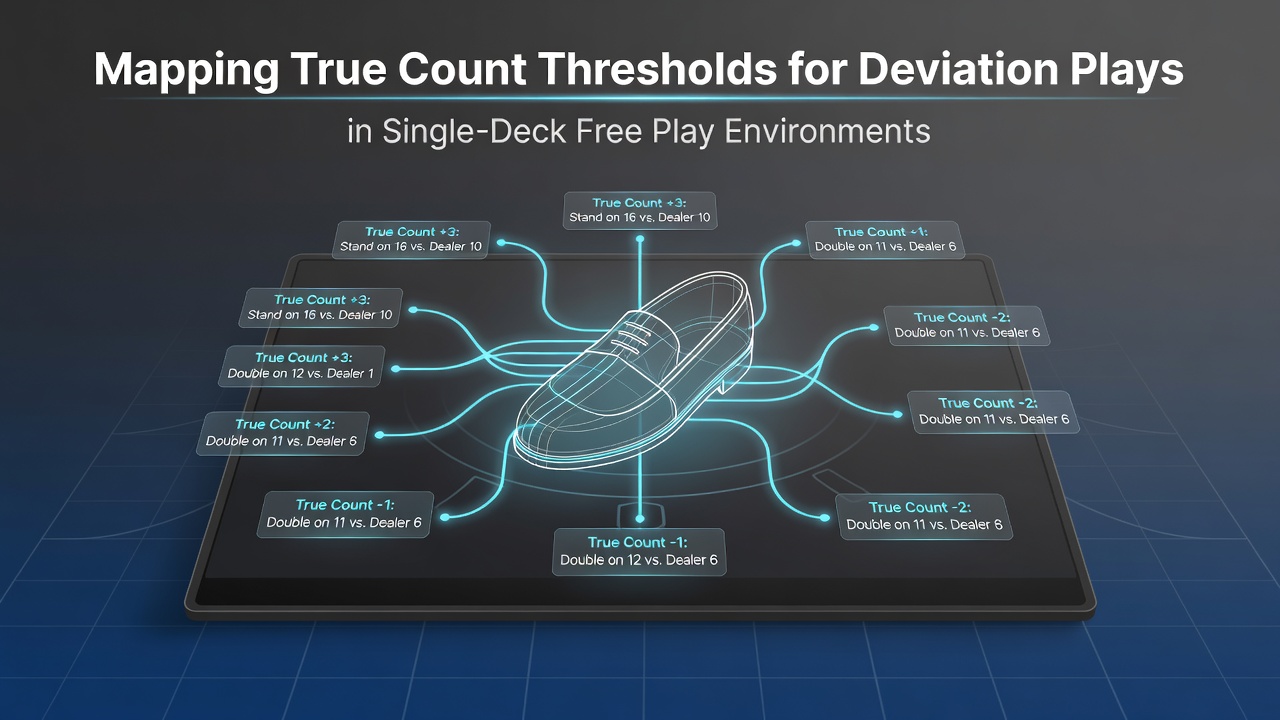
Single-deck blackjack creates unique opportunities for strategy deviations when players track the true count, and free play environments allow detailed mapping of those thresholds without financial risk. Researchers have documented specific true count levels where basic strategy adjustments yield measurable edges, particularly in one-deck formats that feature higher volatility than multi-deck games.
Core Concepts Behind Deviation Thresholds
Deviation plays occur when the true count signals a departure from basic strategy recommendations, such as taking insurance or altering doubling decisions. In single-deck settings the running count converts to true count by dividing by the estimated remaining decks, which produces sharper swings and earlier threshold crossings than in deeper shoes. Free play platforms replicate these dynamics through randomized shuffling algorithms that maintain single-deck composition while permitting unlimited session resets.
Simulation data from university research labs indicates that insurance deviates at a true count of +3 in single-deck play, whereas certain soft doubling decisions shift at true counts between +1 and +4 depending on the exact player total and dealer upcard. Observers note that these thresholds remain consistent across free play interfaces because the underlying probability models mirror live single-deck conditions.
Mapping Specific Thresholds for Common Deviations
Players who monitor running counts can identify precise points where strategy changes become optimal. For 16 versus 10 the deviation activates at true count +0 in single-deck, while 15 versus 10 requires +4. These values derive from combinatorial analysis that accounts for the exact card removal effects present in one-deck formats.
Additional thresholds include doubling 9 versus 2 at true count +1, doubling 10 versus 9 at +4, and standing on 16 versus 9 at +5. Each level corresponds to an expected value crossover documented through exhaustive Monte Carlo runs that process millions of hands per configuration.
Impact of Free Play on Threshold Application
Free play environments remove bankroll constraints and let users test threshold adherence across thousands of hands without variance pressure. Data shows that repeated exposure to single-deck sequences helps users internalize when the true count crosses each deviation point. Because free play resets occur instantly, practitioners accumulate sample sizes that would require weeks of live table time.
Industry reports from the American Gaming Association reveal that operators have expanded single-deck free play offerings in 2025 and 2026 to meet demand for practice tools that mirror regional rule sets. These platforms often include real-time true count displays during tutorial modes, allowing direct correlation between displayed counts and recommended deviations.
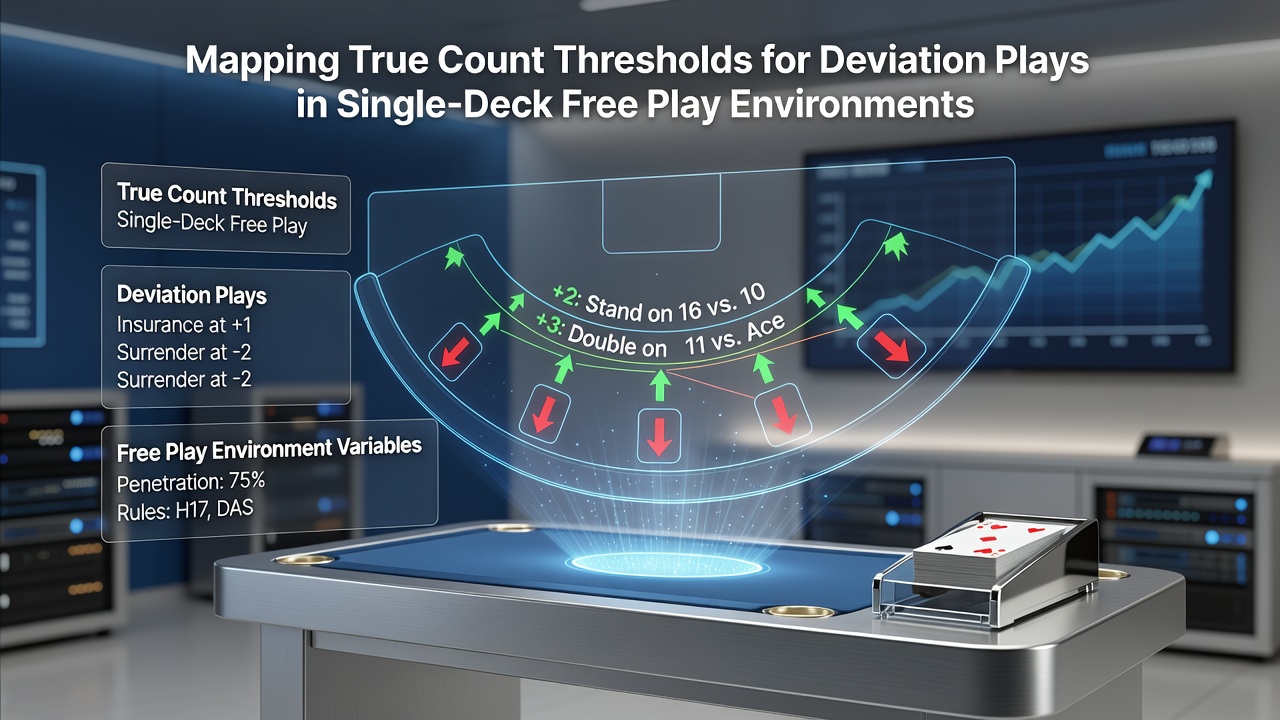
Regional Variations and Rule Interactions
Single-deck rules differ by jurisdiction, which alters some deviation thresholds. In markets where dealers stand on soft 17 the insurance threshold stays at +3, yet doubling decisions for certain totals shift by one true count level compared with hit-soft-17 environments. Canadian provincial gaming data collected through the Alcohol and Gaming Commission of Ontario demonstrates that rule variations produce measurable differences in deviation frequency during extended free play trials.
European regulatory bodies, including those overseeing online platforms, have noted similar patterns when single-deck variants appear in practice modes. These observations confirm that threshold mapping requires calibration to the exact rule set active in each free play session.
Simulation Validation and Practical Threshold Charts
Comprehensive simulations published through academic channels at institutions such as the University of Nevada, Las Vegas confirm the stability of single-deck deviation thresholds across sample sizes exceeding ten million hands. The resulting charts list each player total, dealer upcard, and corresponding true count activation point for both stand/hit and double decisions.
Users of free play tools can cross-reference these charts in real time, adjusting actions only when the displayed true count meets or exceeds the documented level. This approach maintains mathematical precision while eliminating guesswork during practice sessions.
Conclusion
Mapping true count thresholds for deviation plays in single-deck free play environments provides a structured framework for understanding when basic strategy adjustments become advantageous. The documented levels remain consistent across simulations and regulatory observations, offering clear benchmarks that apply uniformly in practice settings. Continued refinement of these charts through expanded simulation work supports precise strategy application whenever single-deck formats appear in free play contexts.